


An Overview About Carbon Fiber Thermal Properties
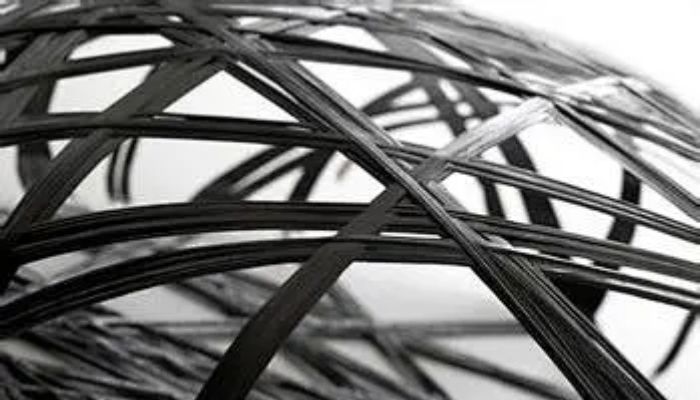
Thermal conductivity and thermal expansion coefficient are two important thermal performance indicators in carbon fiber applications.
Therefore, this guide helps you understand and learn about these two thermal properties comprehensively from their definitions, applications, challenges, and solutions. This will help you optimize and enhance your product solutions by improving the performance of carbon fiber composites.
1. What is Carbon Fiber Thermal Conductivity and the Thermal Expansion Coefficient?
1)Thermal Conductivity:
It is an indicator to measure the thermal conductivity of the material. It refers to the heat transferred by heat per unit area per unit time per unit temperature gradient. It’s expressed in K and the unit is W/mK
Formula follows:
K=QL/AΔT
K = thermal conductivity (W/mK)
Q = The heat transferred by material, in (W) or (Btu)
L= Distance in the direction of heat transfer, in (meter) or (feet)
A = Cross-sectional area in the direction of heat transfer, in (square meters) or (square feet)
ΔT =Temperature difference during heat transfer, in (K) or (°F)
In different types of carbon fiber, the thermal conductivity is also not fixed and different. The higher the degree of carbonization, that is, the higher the fiber modulus, the higher the thermal conductivity, ranging from 10-800W/mK. Please see below for a comparison with other materials.
| Material | Thermal Conductivity(W/mK) |
| Adamas | 5300 |
| Carbon Fiber(T700) | 750 |
| High Modulus Carbon Fiber(Fiber only) | 120 |
| Silver | 420 |
| Copper | 400 |
| Gold | 320 |
| Aluminum | 230 |
| Iron | 85 |
| Standard Modulus Carbon Fiber | 10-20 |
2)Coefficient of thermal expansion (CTE):
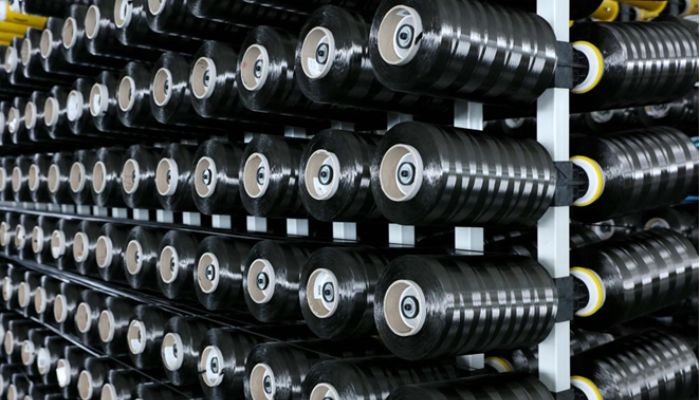
It’s used to measure how the size of a material or object changes when the temperature changes. It’s expressed in α, generally in k-1 or 1/K.
The CTE types are generally divided into three: linear, area, or volume.
The linear thermal expansion coefficient formula follows:
α =L/ΔLΔT
α = Coefficient of linear thermal expansion, (K-1 or 1/K) or (° f-1 or 1/°F)
L= Original material length, (m) or (ft)
ΔL = Material length variation, (m) or (ft)
ΔT =Temperature change, (K) or (°F)
The area thermal expansion coefficient formula follows:
α =A/ΔAΔT
α =Coefficient of area thermal expansion, (K-1 or 1/K) or (° F-1 or 1/°F)
A= Original material area, (m²) or (ft²)
ΔA = Material area change, (m²) or (ft²)
ΔT = Temperature change, (K) or (°F)
Similar to thermal conductivity, the coefficient of thermal expansion of carbon fibers varies greatly. The coefficient depends largely on the direction of the carbon fiber in the composite matrix. Please refer to the table below for the coefficient of thermal expansion of carbon fiber and other materials.
| Material | Thermal Expansion Coefficient( 10-6 /K) |
| Carbon Fiber Reinforced Epoxy Composites(lengthways) | -0.1-0.5 |
| Full Carbon Fiber(length-wise direction) | -0.1-1.5 |
| Full Carbon Fiber (vertical direction) | 25-50 |
| Fiberglass | 5-8 |
| Titanium Alloy | 8.2 |
| Aluminum | 24 |
| Steel | 13 |
| Copper | 18 |
| Ceramic | 2-5 |
| ABS Plastics | 80-100 |
2. Thermal properties of carbon fiber applications
We’ll make a difference to your industry solution. So we can manufacture carbon fiber composites with high thermal conductivity and low thermal expansion coefficient to meet your needs to improve the performance of your application.
Utilizes high thermal conductivity and low coefficient of thermal expansion in fiber direction (longitudinal).
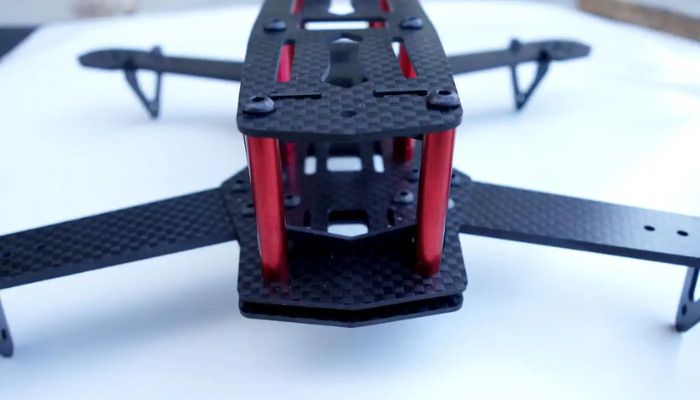
One of the outstanding properties of carbon fiber is high, thermal conductivity and low thermal expansion coefficient. Especially in the direction of fiber, the coefficient of thermal expansion is generally negative or infinitely close to 0. Therefore, using this feature, we can make the composite materials that you require.
- Precision surveying equipment: A low coefficient of thermal expansion allows instruments made of carbon fiber to change size very little when the temperature changes. Such as high-precision requirements of optical instruments, telescopes, and architectural surveying tripods.
- Aerospace: High thermal conductivity and low coefficient of thermal expansion, allowing spacecraft accessories to maintain dimensional stability at both low and high temperatures.
- Uavs: The drone frame structure made of carbon fiber material can survive high-temperature environments without deformation. At the same time, it improves the heat dissipation capacity of the motor and improves the flight performance. Reduce fatigue damage caused by thermal stress and extend its service life.
By using the different thermal conductivity of carbon fiber, the high thermal expansion coefficient in the vertical direction can be reduced by changing the fiber layup direction and matrix selection.
It is well known that the coefficient of thermal expansion in the vertical direction of carbon fiber is higher than that in the fiber direction. The material has poor dimensional stability. Therefore, the use of 0°/90°/45° cross layup direction can reduce its thermal expansion coefficient, while balancing carbon fiber anisotropy and taking advantage of its high thermal properties.
- Automotive manufacturing: carbon fiber composite materials will reduce the coefficient of thermal expansion after changing the direction of the fiber cloth. It is applied to parts such as the hood, chassis, and brake system of the car to ensure that its size does not deform under a high-temperature environment. In addition, its high thermal conductivity is used to prevent thermal stress fatigue caused by high temperatures.
- Outdoor sports equipment: The low thermal conductivity of carbon fiber bicycle frames, golf rackets, and kayak paddles provides good thermal insulation and improves user comfort. And its low coefficient of thermal expansion plays a role in stabilizing the size of the equipment.
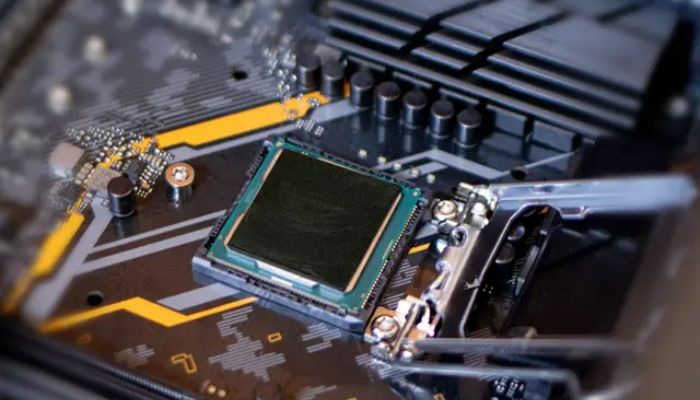
- Heat dissipation equipment of electronic components: The use of carbon fiber composite materials to add other materials such as asphalt can significantly reduce its transverse thermal expansion coefficient, improve the dimensional stability of the heat dissipation device, and use its high thermal conductivity to improve the heat dissipation capacity.
3. Challenges and Solutions
Challenge 1: Thermal stress caused by the anisotropy of carbon fiber materials
We all know that the thermal conductivity and thermal expansion coefficient of carbon fiber are very different in vertical and horizontal directions. That is anisotropy, which will lead to uneven heat distribution when the temperature changes inside it. And it is very easy to fracture or delamination.
Solution
- The layering direction of multi-angle fiber cloth is adopted, such as the direction of 0°/±45/±90° cross layering. Reduce its anisotropy, and finally play a role in balancing its thermal conductivity and thermal expansion coefficient.
- Select a matrix with low thermal expansion: When manufacturing carbon fiber reinforced composites, the higher the thermal expansion coefficient of the selected matrix, the higher the manufactured material’s thermal expansion coefficient. Therefore, the matrix with low thermal expansion can reduce the coefficient of thermal expansion in the vertical direction and improve the overall dimensional stability
Challenge 2: In a high-temperature environment, the performance is easy to degrade.
Substrates in carbon fiber composites, such as epoxy resins, tend to melt or decompose at high temperatures. Eventually, the thermal expansion coefficient will change and the dimensional stability will be affected.
Solution:
- Use high-temperature-resistant epoxy resin or other polyether ether ketone PEEK resin to improve dimensional stability.
- The surface of the composite is coated with a high-temperature-resistant coating to prevent the matrix from losing its performance in a high-temperature environment.
Challenge 3: Data is difficult to control and measure
Thermal conductivity and thermal expansion coefficient are affected by the production process, base material, fiber orientation, and other factors, so it is difficult to accurately measure and control.
Solution:
- Use standardized measurement methods such as ASTM E831
- Real-time monitoring and feedback: The introduction of real-time monitoring technology in the production of carbon fiber composites. Dynamically adjust the data to closely control its thermal conductivity and coefficient of thermal expansion.
- Build material production database: accumulate experience and record data in real-time during the production process. And establish the material database. Provide accurate data reference and technical support for design and production.
4. Conclusion
With a deep understanding and discussion of the thermal conductivity and thermal expansion coefficient of carbon fiber, you can better balance its anisotropy and dimensional stability in product design. Adapt to your application to increase the market competitiveness of your products.
If you need more specific cases, detailed data support, or a variety of carbon fiber plates, tubes, rods, and other shaped accessories, please contact JCCMFG.
 English
  Japanese
  German
  Spanish
  French
  Italian