


How to Drill Carbon Composites?
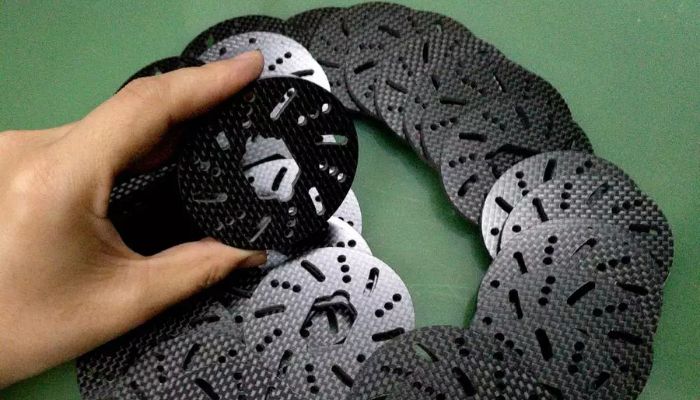
The production cost of carbon fiber composite materials is very high. Without professional tools and processes to be drilled, the expensive parts will become waste products because of a slight error. This guide will provide you with a reliable drilling solution from the aspects of drilling tools, parameters, and steps to ensure the quality of your products.
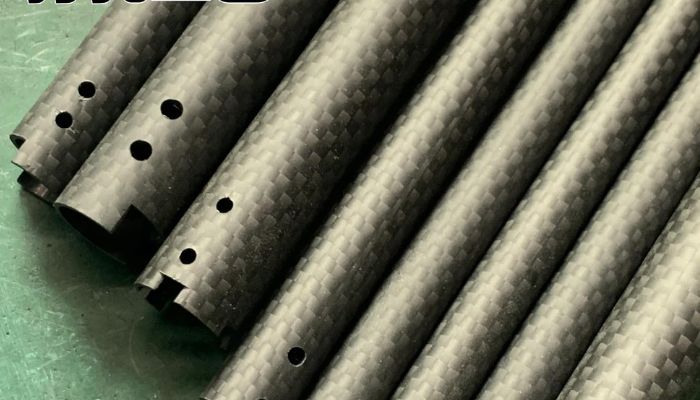
1. Learn About Carbon Fiber Composites
The composite carbon fiber plate is layered. Because of its unique anisotropy and high brittleness, the secondary processing–drilling is very difficult. In particular, 0° laminates and unidirectional composites are more prone to fracture, delamination, and burring when drilling. Therefore, special tools and processes are required to complete a high-quality drilling process.
2. Challenges for Drilling Into Composites
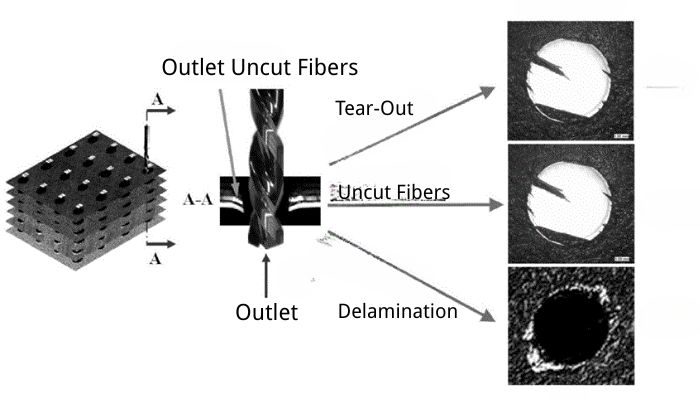
- Delamination: It’s caused by the excessive axial force of drilling when the drill bit is close to the hole outlet.
Solution: The feed rate should be reduced at the hole inlet and outlet, and the step drilling force process + rigid backing should be used.
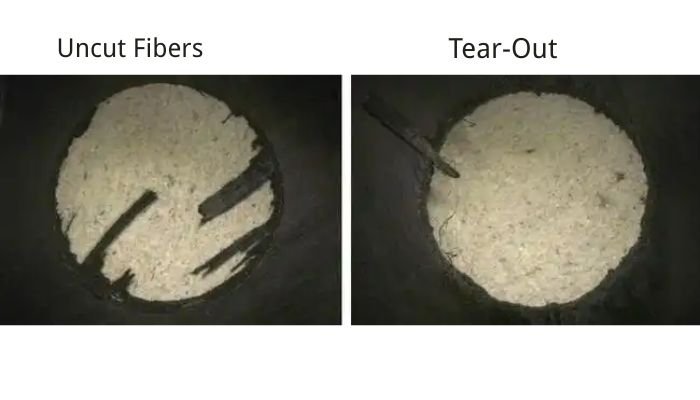
- Tear-out and fracture: After the bit is worn and passivated, the fiber tissue will be torn off from the composite laminate at the exit, and the mechanical properties of the entire surface will be reduced.
- Uncut Fibers: It’s caused by tool wear and passivation. The drill cutting edge is not sharp enough to cut and break the fiber layer of the composite laminate.
- Cutting Edge Wear: Carbon fiber composite hardness is high (about HV 300-500). And the service life of standard drill bits is only 1/10 of that of aluminum.
- Cost and processing efficiency: The composite cost is very high. The drilling caused by brittleness is too difficult, so the scrap rate is very high. Also, the high wear rate of drill bits brings high costs.
- Disabled due to high temperature: When the composite laminate is thick, the high-speed mechanical rotation will cause the surface temperature to be too high. If the cooling is insufficient, the high temperature will make the resin in the composite material soften at high temperature.
- Aperture deviation: Bit wear or vibration offset.
3. Material and Type of Drill Bit
Material:
- High-speed Steel: Suitable for a small number of holes (less than 10), the disadvantage is poor wear resistance and rigidity.
- Carbide Drill: It’s suitable for the manual operation of composite materials, including prototype proofing and non-critical hole drilling. It has better wear resistance and hardness. If the bit surface is coated with tungsten, the hardness can be increased. Service life is 80-100 holes/blade.
- Diamond Coated Carbide Drill: Because of the coating, the hardness of the drill is very high (about HV8000-9000) with high wear resistance. It’s generally used to drill high-precision holes (such as aircraft structural parts) with a service life of 800-1000 holes/blade.
- Polycrystalline Diamond Drill(PCD): Advantages: It has good wear resistance and thermal stability, suitable for large-scale, mass production (such as automotive carbon fiber parts). Service life 3000-5000 holes/blade.
Bit Type:
Twist Drill
- Structural Features: The Point Angle is about 120°, and the Helix Angle is about 30-40°.The transverse Chisel Edge is wide and easy to stimulate the axial thrust of the bit.
- Disadvantages: The wide transverse edge makes it easy to layer the composite material when drilling. Poor chip removal makes it easy to burn the resin matrix and destroy its performance.
- Applicable Scene
-
- Non-structural parts with low precision requirements(Such as decorative carbon plates)
- Shallow hole with aperture ≤3mm and thickness of composite plate ≤2mm.
- Recommended Engine Speed: 500-5000 RPM
Double Angle Composite Drills: Prevents layering and push-out
- Structural Features: One drill double Angle, cutting in grade
- 130°Primary Point Angle: It can disperse the cutting pressure and increase the contact area between the sharp Angle and the laminate. Ensure smooth cut into the surface fiber, avoid the fracture stratification caused by the drill just cut in not deep slip, protect the surface of the composite plate, and inhibit the surface peel.
- 60°Secondary Point Angle
- The sharper bit angle cuts through the underlying fibers quickly and precisely, avoiding exit delamination and Burr.
- Advantage: It can reduce the axial impact force when drilled through, and prevent the fiber tissue at the exit from being “pushed out”.
Trident Drill: Prevents rough edges and tears
- Structural Features
- The three-edge design–60° center main blade +130° top angle symmetrical secondary edge on both sides. The drill chip force is uniform, with no wear around the aperture, and the precision is high, suitable for relatively thick plates
- The chute is wide and deep, and the chute melting space is large and relatively easy
- Recommended Revolving Speed:3000-4000 RPM(Prevent performance failure caused by overheating of resin matrix)
- feed rate: 0.03-0.06 mm/rev
4. Precision Control of Drilling Process Parameters: Taking UAV Accessories as An Example
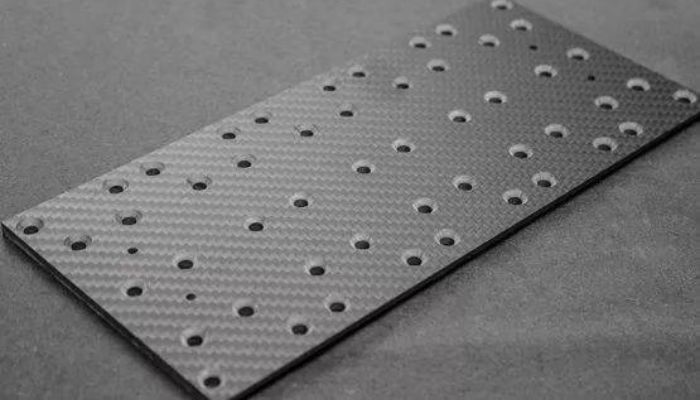
UAV parts ordered by a German UAV manufacturer use diamond drill bit coated tungsten(to improve its hardness)+4000-5000 RPM+ 0.05-0.08mm /rev → Holes’ quality pass rate is greatly improved.
| Parameter | Recommend Data | Adjust Logic |
| Rotate speed(RPM) | 4000-5000(hard alloy) | High speed reduces cutting force per tooth and reduces bit wear, but it needs to avoid overheating to soften the resin by high speed and disable the composite material. |
| Feed rate(mm/rev)–entrance | 0.05-0.10 | The low feed rate avoids fiber grip on the surface and reduces fracture delamination |
| Feed rate(mm/rev)–exit | 0.02-0.08 | The feed rate at the hole outlet needs to be reduced to reduce the risk of stratification |
| Cooling mode | cutting compound | The suitable cutting fluid selected according to the material characteristics plays the role of cooling and lubrication. |
5. Operations Guide
- Wear protective equipment, long-sleeved gloves and dustproof clothing, dust mask or respirator, eye shield, vacuum cleaner, etc. Ventilation is also required during drilling.
- Manual positioning or laser positioning: Positioning the holes before drilling helps ensure drilling accuracy.
- Local reinforcement: Pre-attach anti-stripping tape (e.g. 3M™ 2216) around the positioned points.
- Test drilling and parameter optimization: Before batch drilling, it’s necessary to drill a sample hole to test the stratified fracture and the hole’s accuracy. The drilled aperture was measured with a coordinate instrument and the hole roughness was observed.
- Pre-drilling the pilot hole: Before drilling, drill a pilot hole with a diameter of approximately 0.098 inches. This helps to maintain the stability of the hole size and makes it easy to drill a better-quality hole. It can also avoid the high temperature caused by high-speed rotation.
- Pre-drilling the pilot hole: Before drilling, drill a pilot hole with a diameter of approximately 0.098 inches. This helps to maintain the hole size stability and makes it easy to drill a better-quality hole. It can also avoid the high temperature caused by high-speed rotation of the composite laminate.
- Grinding: When burring occurs near the hole, it is necessary to use a diamond file for hand grinding or a plasma deburring machine to remove burring.
- Inspection: Use ultrasonic scanning of the parts after drilling to detect whether there is stratification (stratification area ≤1% is qualified)
6. Conclusion
The precision of carbon fiber composite drilling directly determines the quality and brand trust of product parts and components. We offer a complete solution from bit selection to parametric design to customized cutting processes to help you achieve zero defect product parts.
Contact us today for efficient drilling!
 English
  Japanese
  German
  Spanish
  French
  Italian