


Carbon Fiber vs Kevlar–Ultimate Guide to Help You Choose the Right Composites

Why is carbon fiber chosen for high-performance car parts and aerospace components? At the same time, Kevlar is the first choice for body armor and ballistic helmets in the military and security sectors.
As the two most important materials in reinforcement composites, they seem similar but have their own merits. Whether you are a materials enthusiast and novice, a materials engineer and designer, or a decision maker in the materials industry, understanding and learning the differences between carbon fiber and Kevlar is crucial to choosing the right material that suits your specific needs.
Next, we will delve into the product characteristics of these two high-performance materials, their application scenarios, and how to choose the most suitable material for your needs.
Below is a comparison of the two materials. We hope it will deepen your understanding of carbon fiber and Kevlar and guide you in making informed material choices based on your specific application needs.
1. Definitions and essential differences
Carbon fiber: Lightweight King
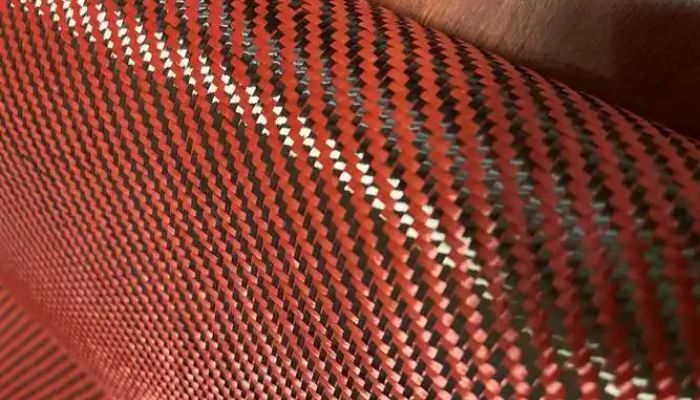
Carbon fiber is a high-modulus, high-strength, and low-density fiber material made of PAN polyacrylonitrile, petroleum, or asphalt that is cracked at high temperatures and has a carbon content of more than 90%.
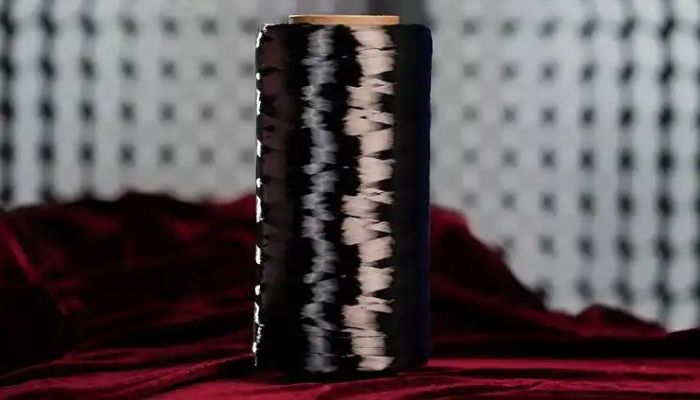
Kevlar: Impact Resistance Expert
Kevlar, also called aramid fiber material, is a polymer polymerized from p-phenylenediamine and terephthaloyl chloride. It has the properties of high wear resistance, high tear resistance, and high tensile strength.
|
Dimension |
Carbon fiber | Kevlar |
| chemical nature | Inorganic polymer materials containing more than 90% carbon | aramid fiber organic polymer |
| Material Form | Rigid composite materials (requires resin matrix curing) | Flexible fibers (can be woven into fabric or laminate) |
| microstructure | Graphite crystal layered arrangement |
Benzene ring-amide bond molecules are arranged in parallel |
2. Production process comparison
Carbon fiber manufacturing process
Raw filament preparation (polyacrylonitrile (PAN), petroleum or asphalt) → Pre-oxidation (200-400°C in the air) → Carbonization (1000-2000°C in oxygen-free nitrogen) → Graphitization (2500-3000°C) → Surface treatment ( to improve the bonding performance of carbon fiber and composite material matrix, surface treatment, sizing, drying, and other processes are required.)
Energy cost: Graphitization furnace electricity consumption accounts for 35% of production costs
Technical barrier: High modulus carbon fiber requires ultra-high temperature pure nitrogen environment control
Kevlar manufacturing process
Solution spinning method (DuPont patented process): Condensation of p-diphenylamine + terephthaloyl chloride into polycondensation of terephthaloyl chloride (PPTA) → polymerization reaction → then dissolve the polymer in a solvent (such as concentrated sulfuric acid solution) → wash and stretch for spinning → finally form the required network fiber material and wind it into yarn
Environmental challenge: The recovery rate of concentrated sulfuric acid needs to reach 99.8% to control costs
Process characteristics: Liquid crystalline spinning achieves high molecular focus
3. Performance comparison between carbon fiber and Kevlar
Carbon fiber and Kevlar have obvious differences in physical and mechanical properties. Carbon fiber is mainly composed of carbon elements and has low density, high strength and stiffness, high-temperature resistance, corrosion resistance, and other properties. Its density is approximately 1.75 g/cm³, and after high-temperature treatment, the density can reach 2.0g/cm³. The microcrystalline structure of carbon fiber enables it to exhibit extremely high strength and stiffness along the fiber axis and is anisotropic.
In contrast, Kevlar is an aramid composite fiber material, whose full name is polyphenylene terephthalamide. It has high strength, high wear resistance, high tear resistance, heat resistance and flame retardancy, antistatic properties, and acid and alkali resistance. The density of Kevlar is 1.44-1.46 g/cm³. Under the same size, it’s lighter than carbon fiber, and its strength is 5 times that of steel of the same quality, but its density is only one-fifth of steel.
Taking specific carbon fiber and Kevlar as an example, a comparison of core parameters

Therefore, carbon fiber’s core advantage is its high specific rigidity (stiffness/density ratio), which is five times that of aviation aluminum. It also has good fatigue resistance and a strength retention rate of more than 95% under cyclic loads.
The core advantage of Kevlar is its good energy absorption. The energy absorption per unit weight is 8 times that of steel. It has high cutting resistance and requires 4,500N of force to cut a single layer of fabric. It is an ideal choice in the field of military protection.
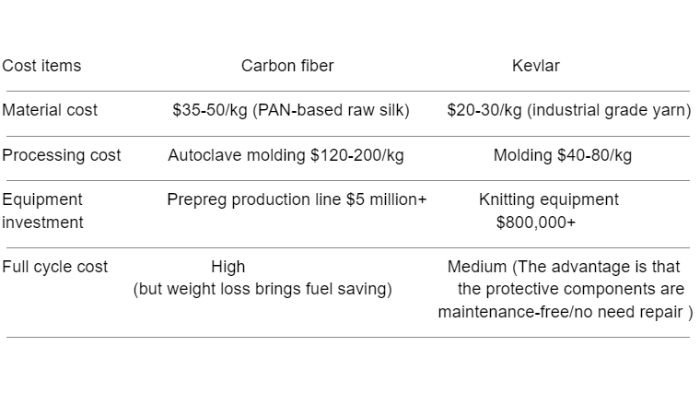
4. kevlar vs carbon fiber cost & price: cost analysis
(Take auto parts–car body panels manufacturing as an example)
5. Comparison of application areas
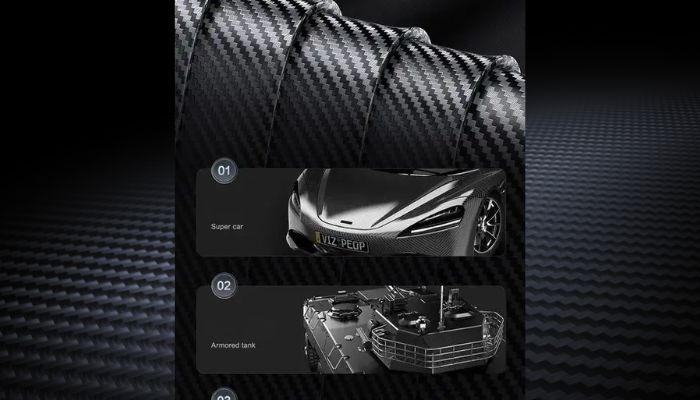
Due to its fatigue resistance, high strength and stiffness, and low density, carbon fiber is generally widely used in aerospace load-bearing structures, brackets, automotive parts, like clutch kits, clutch plates, belts, outdoor sports equipment such as high-performance bicycle frames, golf clubs, paddles and pickleball paddles, kayaks, medical equipment, and industrial equipment.
Kevlar has become the best choice for military and safety protection fields such as body armor, bulletproof motorcycle helmets, goalie masks, hoods, phone cases, and other protective equipment, like firefighter protective clothing due to its high tensile strength, tear resistance, and wear resistance.
6. Integration of cutting-edge technologies
1). Carbon fiber/Kevlar hybrid technology: Carbon fiber can be combined with Kevlar, which can not only ensure the high rigidity and lightweight characteristics of carbon fiber but also take advantage of Kevlar’s high impact resistance. For example, racing chassis and drone shells can use carbon fiber main beam support structures + Kevlar fabric skins, improving performance by 40%.
2). When the carbon fiber surface is connected with silicon carbide nanowires, the interface shear strength can be increased by 65%.
3). After Kevlar fiber is doped with boron nitride, the heat resistance threshold exceeds 600°C.
7. FAQ
1). Is Kevlar lighter than carbon fiber?
Yes, Kevlar’s density is about 1.44-1.46 g/cm³, but the density of carbon fiber is 1.7 g/cm³, so Kevlar is lighter than carbon fiber
2) Is carbon fiber stronger than Kevlar?
If the horizontal comparison dimension is different, the strength of carbon fiber and Kevlar will be different – under static continuous load, carbon fiber has higher compressive strength and fatigue resistance (+18%), but Kevlar’s ability to absorb external energy under dynamic impact is superior.
3)What are the advantages of honeycomb Kevlar composites in ship manufacturing?
Honeycomb Kevlar composite combines a honeycomb core with aramid fiber to ensure lightweight, high tensile strength, and impact resistance. It is bulletproof and especially suitable for the pressure-resistant cabin of deep-water exploration equipment.
4)Is carbon fiber bullet-resistant?
Carbon fiber alone is not bullet-resistant for practical purposes. While it offers high strength and lightness, its brittleness and rigidity make it unsuitable for stopping bullets without reinforcement from other energy-absorbing materials.
8. Conclusion
In the arena of materials science, the game between carbon fiber and Kevlar is not a simple substitution relationship, but a technology combination of “complementary characteristics”.
Through systematic comparative analysis, we can draw the following key conclusions:
Carbon fiber resists steady-state stress with superior strength and stiffness, while Kevlar has high impact resistance, abrasion resistance, and specific tensile strength to handle bullet-level impact damage.
Which material to choose depends on your specific performance requirements for specific field applications. As long as you take advantage of them, they can shine in their respective fields.
 English
  Japanese
  German
  Spanish
  French
  Italian