


What is Stress, Strain, and Elastic Modulus? The Relationship Between Stress, Strain, Elastic Modulus, and Carbon Fiber You Should Know.
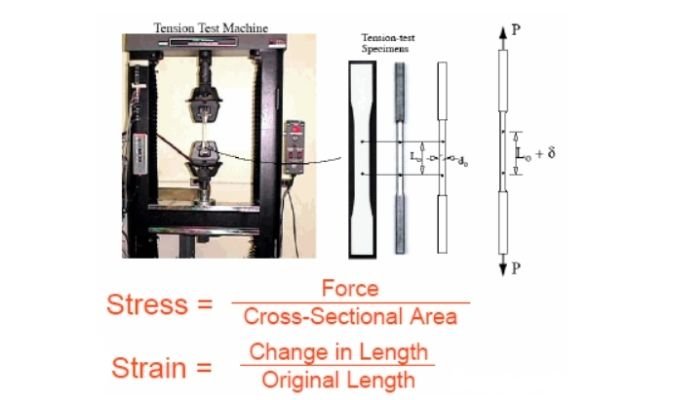
Image Credit: Vable, M., 2002. Mechanics of Materials, New York, NY: Oxford University Press. / Copyrighted
Stress and strain are two crucial parameters in engineering and materials science. They reflect the final state and shape of materials under the action of external forces. The relationship between stress and strain is an indicator that measures elastic modulus. It can reveal many properties of materials, such as rigidity and strength.
This article will unravel the mysteries between them for you one by one and their importance to engineering and design in the carbon fiber manufacturing field. It can help you optimize the design of your carbon fiber products, improve the performance of carbon fiber parts, and promote the development of new carbon fiber reinforced materials and applications to meet your diverse engineering application needs.
What does Stress, Strain, and Elastic Modulus Mean?
Stress:
Stress (σ) is the force exerted on an object per unit area, it’s the applied force divided by the cross-sectional area of the object receiving the force.
Stress σ = F/A,
The unit of F is Newton or pounds (N or lb).
The units of A are ㎡ or in².
The stress value σ is measured in N/m² or lb/in².
Therefore, the larger the area, the smaller the stress when the same force is applied.
How does stress work in carbon fiber materials?
When carbon fiber materials or components are subjected to external forces, the same stress will be generated inside them. The applied external force may cause the fiber materials or components to undergo elastic deformation (recovery bounce-back) or simultaneous elastic and plastic deformation (irreversible deformation damage). Under the action of stress, the atomic bonds inside the material and structural components will resist external forces and equal and opposite reaction forces will be generated inside the carbon fiber material and structural components.
The unique fiber arrangement direction determines that carbon fiber can withstand and transmit stress, especially in the tensile direction, so that stress can be effectively shared.
When carbon fiber is composited with other matrix materials (such as epoxy resin), a good interface can be formed on the surface of the carbon fiber.
It can promote the smooth transition and effective transmission of externally applied deformation force on the carbon fiber surface, strengthen the toughness and impact resistance of the overall structure, and avoid the concentration of local stress to break a certain part of the carbon fiber surface.
In addition, the laminated structure of reinforced composite materials will make the carbon fiber anisotropic. The stress distribution can be optimized by laminating fiber layers at multiple angles and in different directions. When the stress is transmitted along the fiber direction, the carbon fiber material has good mechanical properties in multi-direction.
Strain
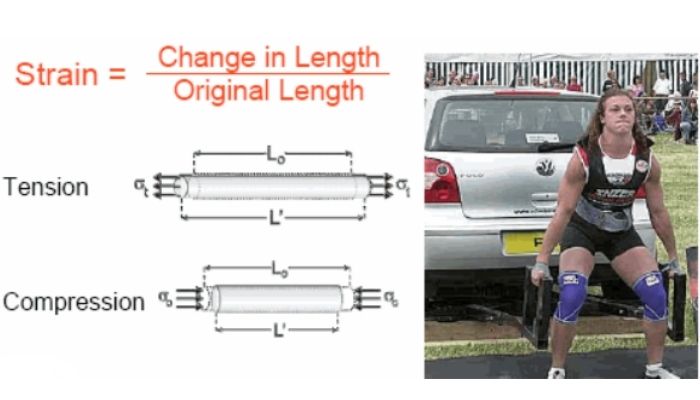
Strain (ε) is an indicator to measure the degree of deformation of a material under the action of external force. It‘s’ the response of the material to stress, which is the change in the length of the material relative to its original length under the action of stress.
Strain ε = dL / L,
dL represents the change in length of the component along the measurement axis (L’-L0) under the action of external force.
L0 is the original length measurement of the component,
Because dL and L have the same units, they cancel each other out, so they have no units.
How does strain work in carbon fiber materials?
Carbon fiber will deform when subjected to external forces, and the degree of deformation can be measured by strain.
The strain behavior of carbon fiber materials or structural components is affected by the fibers’ orientation, the matrix properties, and the interaction between the fiber material and the matrix. In principle, the deformation of carbon fiber materials due to strain is mainly divided into three kinds:
- Elastic deformation
When subjected to low stress, the deformation of carbon fiber materials is mainly elastic, and once the applied force is removed, the material can return to its original state. In other words, within the elastic limit, materials and components can return to their original shape.
- Plastic deformation
When the stress exceeds the elastic limit but is lower than its breaking strength, the carbon fiber material or component will enter the plastic deformation stage.
The deformation at this time is permanent, and the material cannot completely return to its original shape even after the stress is removed. We all know that carbon fiber is brittle and extremely difficult to undergo plastic deformation.
When it is combined with a matrix (such as epoxy resin) to form a reinforced composite material, the matrix will absorb more external forces, thus improving the toughness of the entire composite material.
- Break
When the applied stress exceeds the maximum strength that the carbon fiber material can withstand, the material or component will break or fail. In carbon fiber composite materials, making good use of the interface strength between the fiber and the matrix is crucial to prevent fracture. Good interfacial adhesion can effectively transfer stress and reduce the possibility of failure and fracture for components.
Modulus of Elasticity

Image Credit: Vable, M. Mechanics of Materials, New York, NY: Oxford University Press, 2002. / CopyrightedImage Credit: Vable, M. Mechanics of Materials, New York, NY: Oxford University Press, 2002. / Copyrighted
How are stress and strain related? The parameter that measures their relationship is the modulus, also known as Young’s modulus or elastic modulus (E). It is an index for measuring the elasticity of a material, that is, the ratio of stress and strain. It represents the strain response of the material when it is stressed. It is a numerical measure of the stiffness of a material.
Elastic modulus E = σ÷ε =(F/A) ÷ (dL/L)
σ is stress
ε is strain
E is the elastic modulus
Hooke’s law accurately describes the relationship between stress and strain. The applicable condition for Hooke’s law is that the stress of the material under stress does not exceed the proportional limit of the material, which means that the material must be elastic and in the elastic deformation stage to apply to Hooke’s Law
Stress-strain curve

Image Credit: https://en.wikipedia.org/wiki/Young%27s_modulus
What is the stress-strain curve?
Stress-strain curves show the relationship between stress and strain in materials and components in materials science and engineering. It is obtained by continuously applying stress to the test material sample and measuring the stress deformation response that occurs in the material sample.
Stress-strain diagrams are often used to analyze the behavior of a test sample material under increasing amounts of external force until failure.
Taking carbon fiber material testing as an example, its stress-strain curve is an important representation of the mechanical properties of carbon fiber materials and can provide detailed indicators of the elasticity, plasticity, hardening, and fracture behavior of the material.
Different test materials have different stress-strain patterns.
Designers and materials engineers can explore important mechanical properties based on your industry needs, which will bring technological innovation to your entire carbon fiber industry.
Its stress-strain curve is usually divided into three stages: elastic deformation stage, plastic deformation stage, and fracture stage.
In the elastic deformation stage, when the applied stress is small and within the elastic limit, the carbon fiber material will return to its original state after the stress is removed. When the applied stress exceeds the elastic limit of the carbon fiber material and is lower than its breaking strength, the material will enter the plastic deformation stage.
The deformation during this stage is permanent and the material cannot fully return to its original shape even if the stress is removed. However, carbon fiber can be combined with matrix materials to form composite materials, such as epoxy resin, which can help the carbon fiber absorb more energy and improve its overall toughness.
Fracture occurs after the plastic deformation stage. When the stress is large enough and exceeds the maximum strength that the carbon fiber material can withstand, the material will fracture and fail.
Whether you are a materials engineer, designer, or industry leader, understanding and controlling these deformation mechanisms can help you design and develop more reliable and efficient carbon fiber reinforced composite materials.
Practical Applications and Importance for Stress, Strain, and Elastic modulus
In the field of engineering design, stress, strain, and elastic modulus are key parameters to ensure structural safety and functionality, and combining them with the application of carbon fiber can play a role in multiple fields.
In the fields of automotive manufacturing and aerospace, carbon fiber is widely used to manufacture car bodies, engine parts, and other structural elements due to its excellent tensile strength and rigidity. The dynamic response and durability of the vehicle can be significantly improved while reducing the risk of failure caused by stress concentration.
Carbon fiber also shows its unique value in the medical field, especially in the manufacture of modern medical devices and stent materials: because of its biocompatibility and high strength, it is used to make lightweight and durable prostheses and orthopedic braces that can withstand the stresses and strains of everyday use while providing essential support and flexibility.
Future development trends of materials science
With the continuous development of nanotechnology and biological science, the application prospects of carbon fiber will be further expanded. More materials engineers are exploring combining carbon fiber with other nanomaterials such as carbon nanotubes and graphene to create lighter, stronger, and smarter composites. These materials may be used in the future for more efficient energy storage systems, smart sensors, and self-healing materials.
Conclusion
Understanding and applying stress, strain, and elastic modulus are critical to upgrading and optimizing carbon fiber and its composites. These parameters not only determine the performance of the material, but also directly affect the research and development, design, and service life of the product.
Materials science, particularly the study of carbon fiber and other advanced materials, is revolutionizing our world, from high-performance sports equipment to ever-evolving advanced medical devices. By exploring the development and applications of these materials, we will not only better understand their potential, but also drive innovation and adoption of these technologies to meet future challenges.
 English
  Japanese
  German
  Spanish
  French
  Italian